
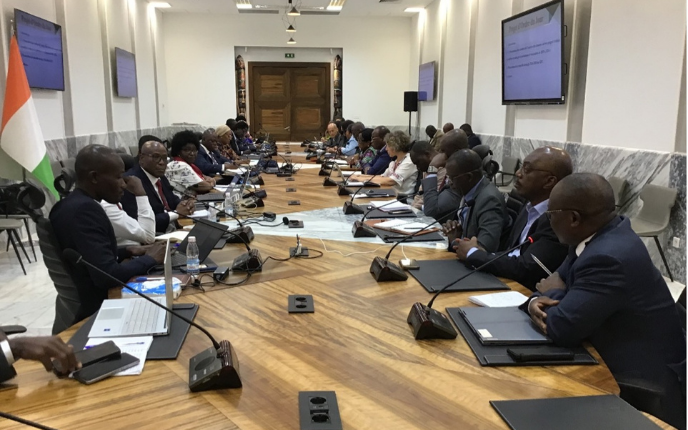
Countdown to 2030 Hosts RMNCAH+N Results Dissemination Workshop at the Prime Minister’s Office
On March 12, 2026, the Countdown to 2030 team in Côte d’Ivoire reached a key milestone in promoting data use for decision-making by organizing a dissemination workshop on the results of multicountry analyses of reproductive, maternal, newborn, child, adolescent health and nutrition (RMNCAH+N) indicators.
The strategic workshop was held at the Prime Minister’s Office, as part of a meeting of the National Health Financing Coordination Platform, a central mechanism for coordinating stakeholders involved in health sector financing.
A strategic space to connect data and financing
The Platform plays a critical role in aligning national health priorities with available resources by bringing together sectoral ministries, technical and financial partners, civil society, and private sector actors.
In this context, the presentation of Countdown analyses had a clear objective: to strengthen the use of evidence to inform financing decisions and improve health system performance.
Key findings to inform public policy
During the session, Countdown experts presented:
- trends in RMNCAH+N indicators between 2019 and 2024
- progress in antenatal and postnatal care
- changes in immunization coverage
- analyses of inequalities in access to health services
These findings, based on a combination of routine data and national surveys, provide a nuanced understanding of the performance of Côte d’Ivoire’s health system and its persistent challenges.
Discussions also raised key issues, including:
- the future integration of data from the ongoing MICS survey
- the sustainable use of analytical tools for national planning
- discrepancies observed between different data sources, particularly on maternal mortality
A dynamic of learning and co-creation
The workshop brought together 36 participants from public institutions, technical and financial partners, civil society, and national programs.
Beyond the presentation of results, the meeting fostered constructive dialogue on the strategic use of data as a lever for action.
Key contributions included:
- the need to integrate determinants such as distance to health facilities into analyses
- identifying factors that have contributed to reducing inequalities in immunization coverage, considered a notable success in Côte d’Ivoire
- the importance of prioritizing key results to support better decision-making
Progress made, but persistent challenges
The discussions also highlighted several structural challenges, including:
- data availability and completeness, particularly in the private sector
- limitations related to the use of models in the absence of comprehensive data
- the need to further strengthen national health information systems
Despite these challenges, Côte d’Ivoire’s data completeness rate, estimated at around 95%, represents a significant achievement to build upon.
Key lessons for the future
The workshop led to several strategic recommendations, including:
- strengthening data quality and reporting, including in the private sector
- improving the integration of data into decision-making processes
- leveraging successful experiences, particularly in reducing immunization inequalities
These directions are fully aligned with the National Health Development Plan toward 2030.
Countdown as a catalyst for data-to-action
Through this initiative, Countdown to 2030 reaffirms its role as a catalyst for translating data into action, supporting countries not only in producing and analyzing data, but also in using it to inform public policies.
This activity illustrates how multicountry analyses can feed into national policy dialogues and contribute to more informed and equitable financing decisions.
Toward sustainable impact
As Countdown approaches the end of its current phase, this type of workshop highlights the importance of:
- consolidating national analytical capacities
- strengthening ownership of results by decision-makers
- ensuring the sustainability of data systems
More than a dissemination exercise, this meeting at the Prime Minister’s Office marks a step toward institutionalizing the use of data in health system governance in Côte d’Ivoire.