
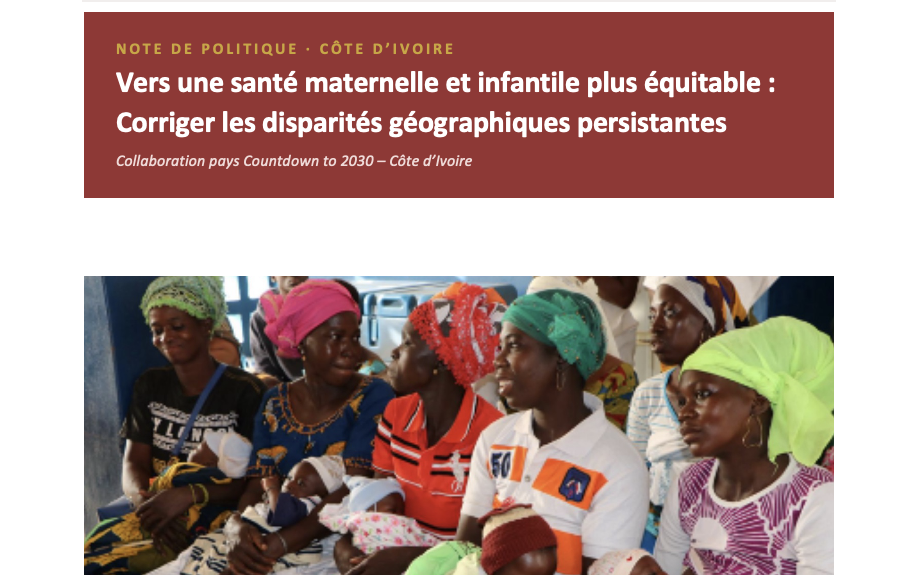
Maternal and child health remains a priority for the Ivorian government. To improve the health of mothers and children, the Ministry of Health, Public Hygiene, and Universal Health Coverage (MSHP-CMU) is implementing several high-impact strategies and interventions:
- Targeted free access to prenatal care, childbirth services, postnatal care, and care for children under five, as well as free family planning services;
- Strengthening emergency obstetric and neonatal care (SONU);
- The development of Regional Health Centers of Excellence (PRES) and regional EONC networks;
- The rehabilitation and construction of health facilities at all levels of the health system.
However, beyond the general improvement in the availability and utilization of services, equitable access to health services, as recommended by Sustainable Development Goal 3, remains a challenge. Disparities in the coverage of interventions exist between health regions and between urban and rural areas. These regional imbalances expose pregnant women, mothers, and children in disadvantaged areas to increased risks of illness and death.
An analysis of progress and performance on maternal and child health indicators over the past decade, conducted as part of the Countdown to 2030 initiative, highlights several inequalities, including those related to geographic access to health services.
Read the report (French):