
This blog post was written by Aniqa Tasnim Hossain, an associate scientist in icddr,b’s Maternal and Child Health Division and a member of Countdown’s Bangladesh country collaboration. It summarizes the recent paper titled, Using DHIS2 routine data for health system preparedness in resource-limited settings: A Bayesian predictive approach in Bangladesh.
Using routine health data to anticipate rising demand and strengthen health system preparedness in Bangladesh
Health systems in low- and middle-income countries often operate reactively, responding to demand as it arises rather than anticipating it. In Bangladesh, this approach contributes to service bottlenecks, inefficiencies, and inequities in access. Addressing these challenges requires a shift toward more anticipatory, data-driven planning approaches.
Routine DHIS2 data can be used not only for reporting but for forecasting and proactive health system planning
Routine health information systems, such as District Health Information Software (DHIS2), are widely used in Bangladesh to track service delivery and generate routine reports. However, their potential extends far beyond retrospective monitoring. When analyzed using appropriate statistical approaches, these data can be leveraged to identify trends, detect seasonality, and generate short- to medium-term forecasts of service demand. This enables health managers to anticipate increases in patient load, allocate human resources more efficiently, ensure timely availability of medicines and supplies, and prepare facilities for predictable surges in demand. In this way, routine data can move from being descriptive to becoming a core tool for forward-looking decision-making.
Our new analysis demonstrates how predictive analytics can support more proactive, data-driven planning. By analyzing monthly service data from 2021 to 2025 and forecasting trends through 2026, the study provides timely insights into how demand for essential health services is evolving. The analysis applied Bayesian log-linear Poisson regression models, incorporating seasonality and autocorrelation, to generate robust projections of service utilization. A Bayesian approach is particularly well suited for routine health data, as it can flexibly handle time-series structure, account for uncertainty through credible intervals, and produce stable estimates even when data quality varies across settings. This analytical approach strengthens the reliability of forecasts and enhances their usefulness for policy and planning.
Rising demand across services with regional disparities and seasonality
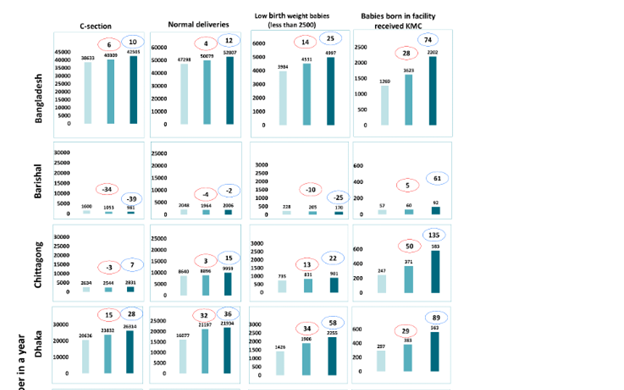
The analysis shows a clear upward trend in service utilization across different domains. Kangaroo mother care (KMC) is projected to increase by more than 75% by 2026, while outpatient visits and pneumonia treatment are expected to rise by around 30%. Hospital admissions are also forecast to increase by over 25%. These increases reflect both demographic pressures and improved care-seeking behavior. However, they also signal growing strain on health system capacity. Understanding how this demand is distributed and when it peaks is therefore critical for effective planning.
Regional disparities in service utilization reflect uneven access to care and differences in health system readiness across the country. Distinct seasonal patterns are also observed, with deliveries and childhood illnesses peaking during specific months of the year. Together, these findings emphasize the need for planning that is both geographically targeted and seasonally responsive, ensuring that resources, staffing, and supplies are aligned with where and when demand is highest. Such insights demonstrate the practical value of forecasting for improving both efficiency and equity in service delivery.
Implications for policy and planning
The findings reinforce the importance of moving from data collection to data use. Without actively translating data into decisions, the full value of routine information systems remains unrealized.
As Bangladesh advances toward universal health coverage, leveraging routine data for predictive planning will be critical for building a more responsive and resilient health system. Ultimately, embedding these approaches within routine practice can transform how health systems anticipate and respond to population needs.