

As part of the family planning multi-country study, a recent article published in the peer-reviewed journal Contraception provides evidence linking women’s empowerment and life-stage to contraceptive method mix across 28 countries in sub-Saharan Africa.
Across the region, implants and injectables remain the most used contraceptive methods on average. However, the research found that higher levels of empowerment were consistently associated with more diversified method mixes and a lower reliance on these two methods. More empowered women were more likely to shift toward methods that offer greater personal control and fewer side effects.
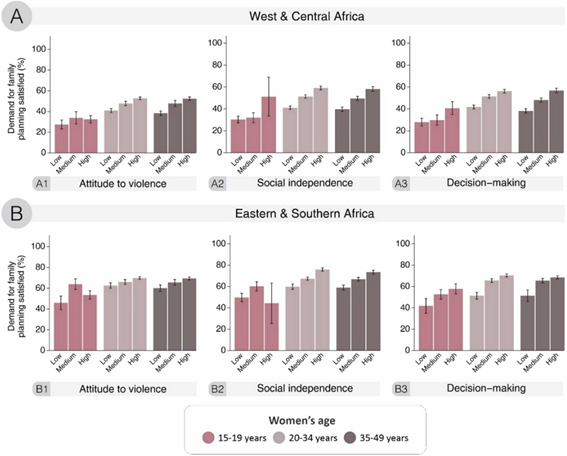
Study authors measured women’s empowerment using the Survey-based Women’s emPwERment index (SWPER), which was developed at the International Center for Equity in Health at Pelotas University, the organization that leads Countdown’s equity data & analysis center.
The findings highlight that women’s empowerment is not only a social goal but a key determinant of reproductive choice. Strengthening women’s agency within relationships, improving their ability to navigate health systems, and ensuring access to a diverse range of contraceptive options should be central to family planning programs — beyond a narrow focus on coverage or method-specific targets.
Programs that foster education, economic opportunities, and reproductive autonomy for women — especially at key life stages — are likely to yield stronger, more sustainable, and more equitable increases in family planning coverage.
Access the article: Women’s empowerment and life stage: assessing intersectional differences in contraceptive method mix in sub-Saharan Africa
Other Countdown articles that have used the SWPER index:
- The SWPER index for women’s empowerment in Africa: development and validation of an index based on survey data
- SWPER Global:A survey-based women’s empowerment index expanded from Africa to all low- and middle-income countries
- Is womens empowerment associated with coverage of RMNCH interventions in low- and middle-income countries? An analysis using a survey-based empowerment indicator, the SWPER
- Gender-Related Inequality in Childhood Immunization Coverage: A Cross-Sectional Analysis of DTP3 Coverage and Zero-Dose DTP Prevalence in 52 Countries Using the SWPER Global Index