

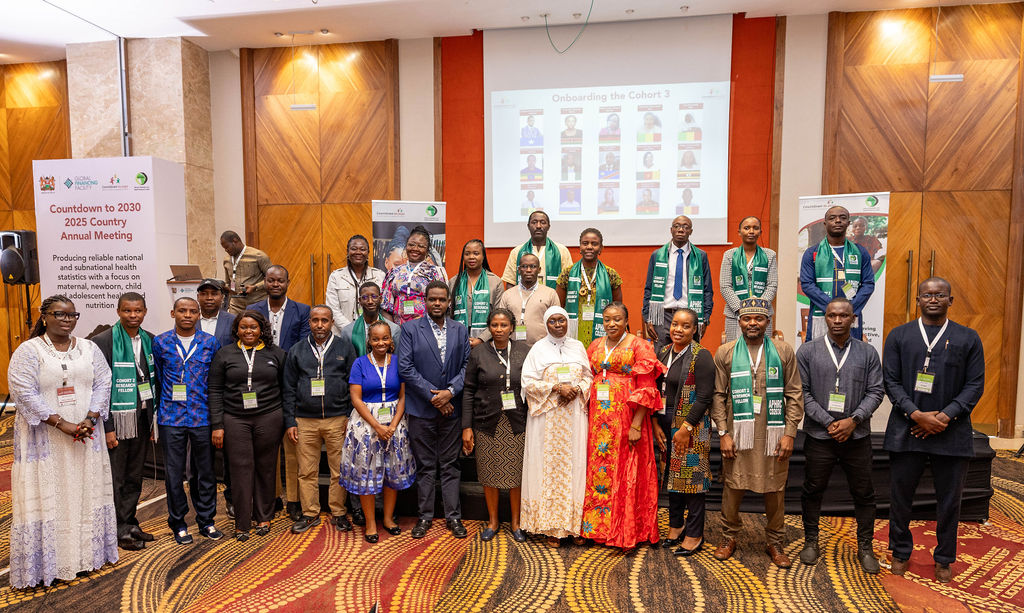
Countdown to 2030 Cohort 2 and 3 fellows pose for a group photo during the 2025 Country Annual Meeting in Nairobi, Kenya.
The Countdown to 2030 fellowship program has supported African researchers in answering meaningful research questions designed to improve the lives of women, children, and adolescents. The first in a series of webinars highlighting fellows’ achievements was held on February 17, 2026.
“Data alone doesn’t change systems,” said Dr. Cheikh Faye, project director of Countdown to 2030. “We need something else. What we need is people who can understand the data and use it. People can change the system.”
This recognition is what led to the fellowship program, which has built on Countdown’s experience in global monitoring and country-led capacity-building and analysis. Over two decades, Countdown has evolved from external monitoring to embedding expertise within African ministries of health, research institutions, and academic institutions, Dr. Cheikh added.
Professor Adama Faye of Senegal’s Institut de Santé et de Développement said that researchers’ first impulse used to be to collect new data, but the Countdown initiative has shown the value of using existing data routinely collected by the Ministry of Health and other institutions. Previously, the data were underused due to a lack of analytical capacity. The program has connected university researchers with ministry representatives, creating an incentive to both publish and use the data. Another benefit of the program has been that fellows have expanded the network of the Ministry of Health, providing connections with academic researchers and others, Dr. Faye said.
Dr. Jennifer Requejo of the Global Financing Facility (GFF) and Johns Hopkins University said that the fellows program complements the GFF’s strategy, particularly the objective around fostering health system sustainability, sovereignty, and resilience.
The fellows who presented in the session were Dr. Sophia Kagoye from Tanzania, Mr. Albert Ndagijimana from Rwanda, Dr. Chikondi Chapuma from Malawi, and Mr. Rogers Nsubuga from Uganda. As examples of impact, they talked about how the fellows program supported them to:
- Influence country processes by having their analyses included in the health sector midterm and annual reviews;
- Provide capacity-building sessions for researchers, students, and analysts in their native countries; and
- Draw attention to underserved populations such as refugees.
Looking ahead, the challenges are to institutionalize, ensure that the fellows’ capacity remains in the country, and further strengthen the bridge between research and health systems provision.